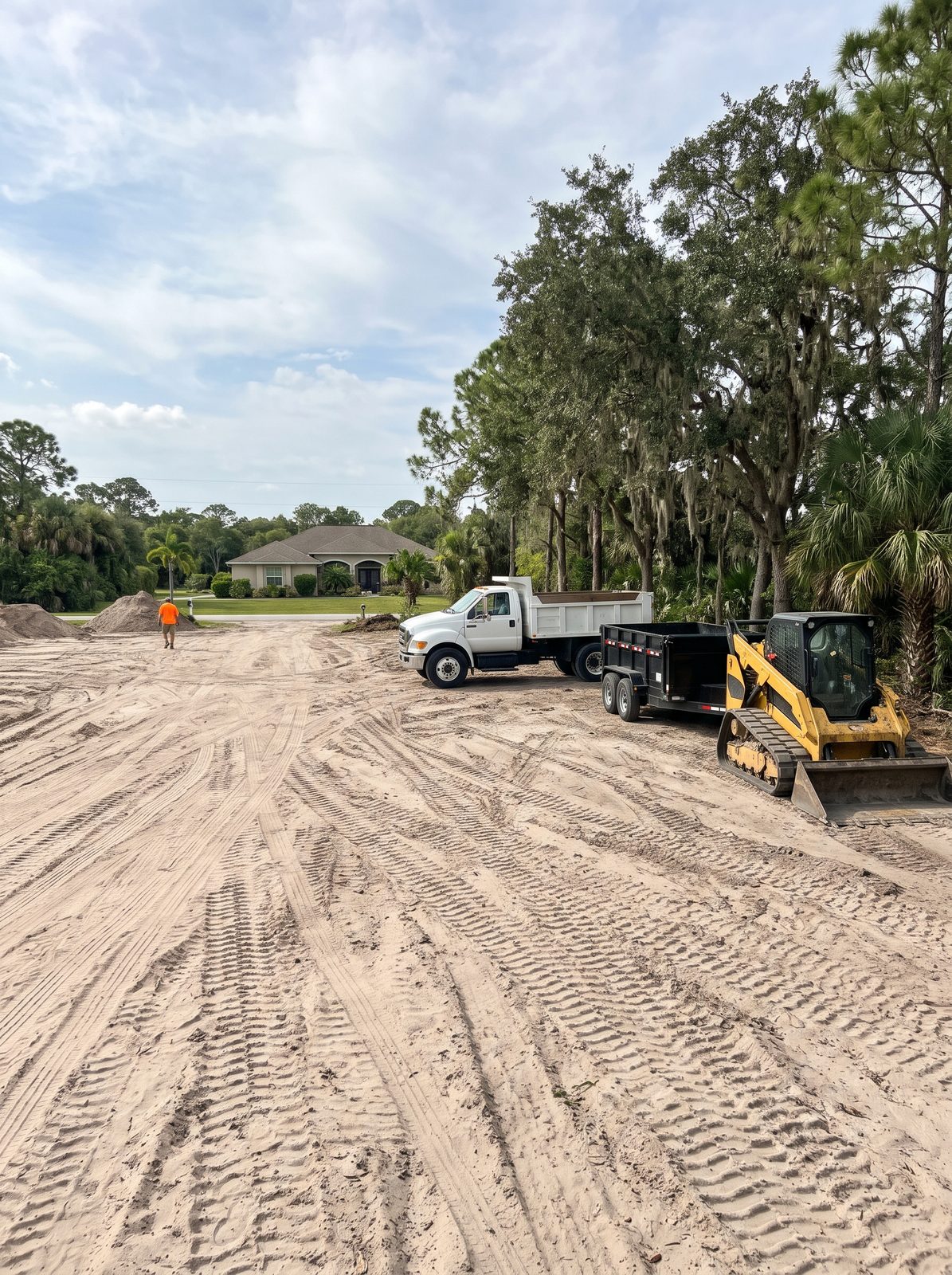
Ask five people what grading costs and you will get five answers, all of them technically correct for some lot somewhere. Grading is the work of shaping the ground to the elevations and slopes on a plan: cutting high spots, filling low ones, compacting, and making sure water flows where it should. In Southwest Florida, where most land is flat, sandy and close to the water table, the price depends less on moving dirt around and more on how much has to be brought in, how wet the site is and what is being built. This guide breaks the cost into its parts so a quote makes sense when you see it.
The Parts of a Grading Bill
Most grading quotes, whether they list them or not, are built from the same pieces:
- Mobilization: getting the loader, dozer, roller or excavator to the site and back.
- Clearing: if the lot is still wooded or overgrown, it has to be cleared before grading starts. This is often priced separately.
- Material: fill, sand, shell rock or road base delivered by the truckload.
- Machine and operator time: spreading, shaping and compacting to the plan.
- Haul-off: removing spoil, roots, muck or buried debris that can't stay.
- Testing and layout: some builders and engineers require compaction tests or surveyed grade stakes.
What Pushes the Price Up or Down
How much fill the site needs
On many Southwest Florida lots, imported fill is the biggest line item. A lot that sits well below the road or the required floor elevation can take many truckloads, while a lot that is already close to grade may need only a few to fine-tune the slopes. In Cape Coral, flood-zone single-family and duplex homes are limited to 12 inches of base fill under the foundation and 30 inches (or a 4:1 slope) elsewhere on the lot unless the Building Official approves more, which can shift money from fill to the foundation design instead.
Site condition
A cleared, dry, mostly level lot is the cheapest to grade. Heavy brush, stumps, old concrete, standing water or pockets of muck all add time, and unsuitable soil may need to be dug out and replaced with clean fill.
Size and shape of the work area
Bigger areas cost more in total but often less per square foot, because setup costs are spread out. Small, tight or irregular areas take more careful machine work.
Access
Narrow streets, low wires, soft shoulders, canals and neighbors' fences all slow trucks and equipment. A site a loaded dump truck can't reach without getting stuck may need a temporary shell-rock entrance first.
Drainage requirements
The Florida Building Code's residential drainage rule calls for the ground to fall at least 6 inches within the first 10 feet from foundation walls, or for swales and drains where the lot can't allow it. Lots that need swales, culverts or engineered stormwater features cost more than lots that only need a gentle slope away from the house.
What is being built
A home pad, a commercial pad, a parking area and a backyard regrade all have different tolerances and compaction targets. Tighter specs mean more passes, more testing and more time.
Season and weather
The wet season, roughly mid-May to mid-October, brings afternoon storms that soften ground and stall compaction. Jobs scheduled in the drier months usually move faster.
Typical Market Numbers for the Material Side
We don't publish a flat per-acre grading rate, because two lots of the same size can differ by several times in cost. But the inputs can be benchmarked. In late 2026, online marketplace listings for Fort Myers started at roughly:
- Fill dirt: about $28 per cubic yard delivered, or about $500 for an 18-yard truck
- Fill sand: about $40 per ton
- Road base: about $41 per ton
- Crushed concrete road base: about $52 per ton
If clearing is needed first, one Lee County company publishes ranges of about $1,500 to $3,500 per acre for light clearing, $3,000 to $6,000 for moderate and $5,000 to $10,000 or more for heavy clearing. Treat all of these as typical market ranges that vary by job, not a quote. Every job is quoted after we see the site. For clearing specifically, see our land clearing cost guide.
How to Keep Grading Costs Down
- Bundle the work. Clearing, fill delivery and grading done by one crew avoids paying for extra mobilizations and waiting between contractors.
- Get the plans first. Grading to an approved site plan avoids redoing the work after an inspector or engineer weighs in.
- Order fill to the plan, not by eye. Too little means a second delivery; too much means paying to move it twice.
- Reuse what you can. Good soil from a high spot or a pool dig can sometimes be spread on site, if the plans and local rules allow it.
- Schedule for dry weather when you have a choice.
How to Compare Grading Quotes
Line up the quotes and check that each one covers the same scope: Is clearing included? How many loads of fill, and what material? Is compaction done in lifts, and is testing included? Who hauls off spoil and debris, and where does it go? Is final grade shaped for drainage, or just roughed in? A lower price that leaves out fill or haul-off often ends up costing more.
We handle grading and site prep, building pad prep and fill delivery out of Fort Myers for job sites across Lee, Charlotte, Collier and Hendry counties. Starting from scratch? Read getting a lot ready to build.
Frequently Asked Questions
Is land clearing included in a grading price?
Usually not. Clearing trees, brush and stumps is normally a separate step priced before grading, since the amount of work varies so much from lot to lot.
Why won't contractors give a per-acre grading price over the phone?
Because fill volume, soil, drainage and access change the cost far more than lot size does. A site visit, plus the site plan if you have one, is what makes an accurate number possible.
Do I need compaction testing?
Many builders and engineers require it for building pads before they form the foundation. Ask your builder what density and test method they want so the grading crew works to that target.
How long does residential grading take?
Once permits and material are lined up, the grading itself on a single-family lot often takes a few days. Rain, large fill volumes and drainage work can stretch it out.
Want a real number for your site? Call or text 914-562-4457 or send us your project details. We will look at the lot and your plans and quote the actual scope.