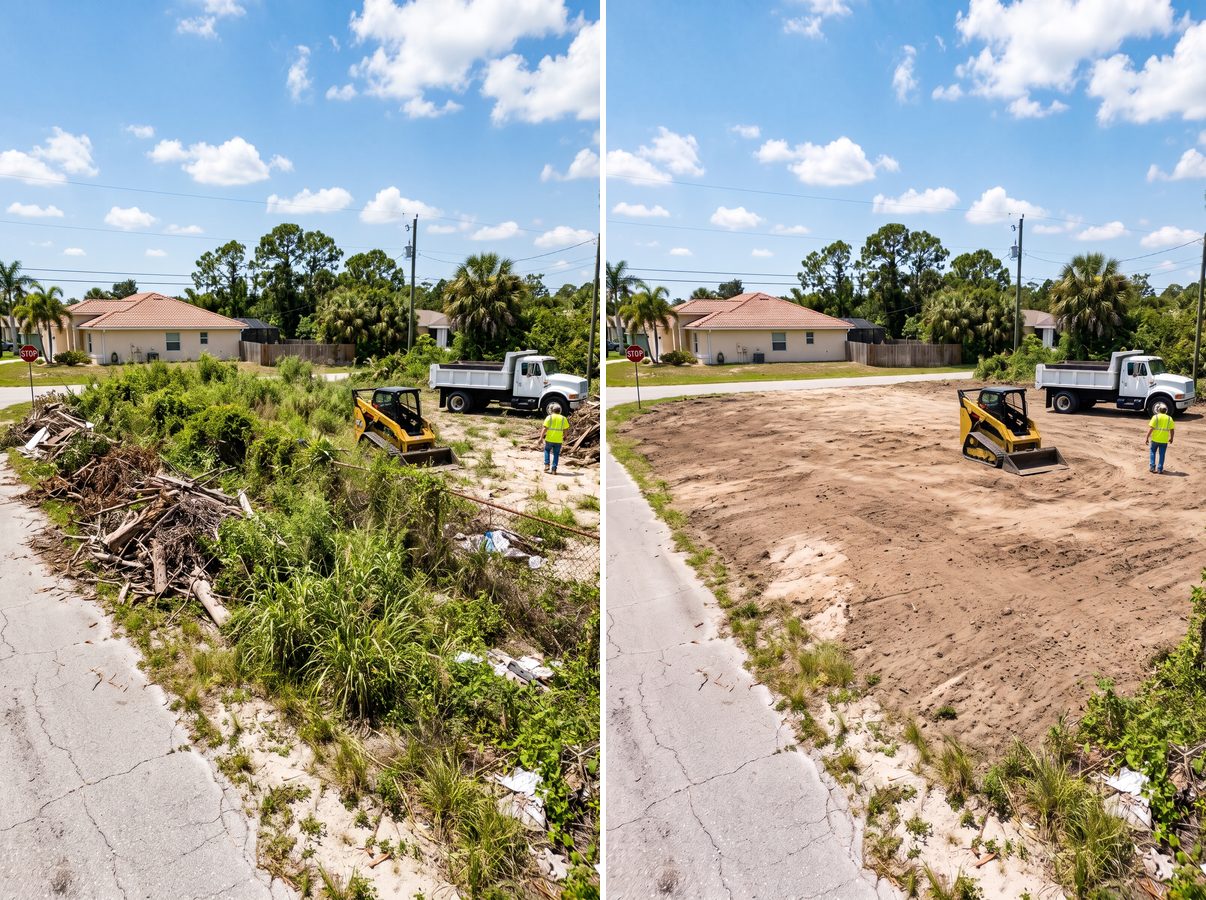
Cape Coral was laid out decades ago as a grid of small residential lots, and many of them have sat vacant ever since. A lot that was mowed a few times in the past may now be a wall of Brazilian pepper, vines and saw palmetto. If you have bought one and are getting ready to build, clearing is the first physical step. From our base in Fort Myers, the Cape is a short drive across the river, and its lots come with a few local rules that are worth understanding before any equipment arrives.
What Makes Cape Coral Lots Different
- Small, uniform lots. Many homesites combine two or more platted lots. Clearing has to stay inside the property lines, because neighbors are close.
- Canals and swales. Waterfront lots back onto canals, and street-front swales carry stormwater. Debris and sediment must stay out of both.
- Utilities at the street. Water, sewer, irrigation and electrical lines run along the right-of-way, so the area near the road needs care.
- Wildlife on vacant land. Open, sandy lots are exactly where burrowing owls and gopher tortoises like to dig.
Step One: Check for Burrowing Owls and Gopher Tortoises
Cape Coral is known for its burrowing owls, and the city's protected species code applies to land clearing, excavation, tree cutting and even mowing on vacant lots. Applicants are expected to do a visual survey of the property for owl and tortoise burrows and report the result with their development application. The city's affidavit for one- and two-family homes asks the applicant to confirm the property and nearby vacant lots were inspected within the last 30 days.
If a burrow is found, the city's procedures call for a buffer of at least 10 feet around it outside nesting season and at least 33 feet during nesting season, February 15 to July 10. If the planned home cannot fit while keeping that buffer, a permit from the Florida Fish and Wildlife Conservation Commission (FWC) is needed before the burrow can be disturbed, and the city suggests applying weeks in advance. For gopher tortoises, FWC says no permit is needed if all burrows are avoided by 25 feet; otherwise a relocation permit and an authorized agent are required.
The lesson is simple: look for burrows before you set a construction start date, not on clearing day.
Step Two: Understand Cape Coral's Clearing and Fill Rules
Cape Coral treats land clearing and fill as site development work that needs city approval, and its code makes it unlawful to place fill on a site without a permit. The rule that surprises many new owners is the fill limit: since August 1, 2025, base fill under the foundation of a single-family or duplex home in the Special Flood Hazard Area is limited to 12 inches, and fill on the rest of the lot to 30 inches or a 4:1 slope, whichever is stricter, unless the Building Official approves otherwise. There are exceptions for septic systems and for driveways, walkways and patios. Builds that need more height must use a foundation such as a stem wall or deepened monolithic slab.
In practice, that means Cape Coral pad work often looks different from Lehigh Acres. Instead of raising the whole lot, fill goes inside the stem walls, around the septic system where needed and under the driveway, with the rest of the lot graded to drain. For more on how permits work across the region, see clearing permits around Fort Myers.
Step Three: Choose Full Clearing or Forestry Mulching
Full clearing
If you are building now, the house footprint, driveway, septic area and work zone usually need to be cleared to bare soil with stumps and roots removed, so fill can be placed and compacted. Debris is loaded and hauled off.
Forestry mulching
If you are holding the lot for later, want to make it presentable for sale, or want to keep native slash pines, oaks and cabbage palms, forestry mulching grinds underbrush in place in one pass and leaves a mulch layer. It does not remove roots, so the build area will still need full clearing later. Our comparison of mulching versus full clearing goes deeper.
Getting Rid of Brazilian Pepper
Brazilian pepper is the most common problem plant on overgrown Cape lots. It forms dense, sprawling thickets and resprouts from stumps and roots if they are left in the ground, so mowing it down only buys time. Removing the root mass, or treating stumps according to label directions where removal is not practical, keeps it from coming back. Air potato vines and other invasives often grow alongside it.
What Happens Once the Lot Is Open
Once the lot is open, the typical sequence is foundation layout, footings and stem walls by the builder, then backfill inside the walls with clean fill compacted in lifts. In flood zones, Cape Coral's construction guidance puts the lowest floor at least one foot above base flood elevation. Finally, the lot is graded so stormwater runs to the swale or canal rather than toward the house or the neighbor's yard. We handle the fill delivery, pad prep and grading and site prep for this stage.
What Affects the Price of Clearing a Cape Lot
- How overgrown the lot is and how many trees are coming out.
- Whether stumps and roots must be removed or the lot can be mulched.
- The number of truckloads of debris to haul away.
- Whether you are clearing one lot or several combined.
- Access, including canal-side work and tight neighboring homes.
For typical market ranges, read land clearing prices around Fort Myers, or see our Cape Coral service area page.
Frequently Asked Questions
Do I need a permit to clear a lot in Cape Coral?
In most cases, clearing and fill are part of the city's site development approvals, and protected species rules apply to clearing and even mowing on vacant lots. Confirm the current requirements for your address with the City of Cape Coral before work starts.
What if there is a burrowing owl on my lot?
Keep at least the buffer the city requires, 33 feet during nesting season from February 15 to July 10. If the home cannot be built while keeping the buffer, an FWC permit is needed before the burrow is disturbed. Plan for that early.
Can I raise my whole Cape Coral lot with fill?
Generally not if it is in the Special Flood Hazard Area. For single-family and duplex homes there, the city limits base fill under the foundation to 12 inches and fill elsewhere on the lot to 30 inches or a 4:1 slope, with room for septic systems and flatwork; homes that need more height use stem walls or deepened slabs.
Should I clear my lot before I am ready to build?
You can, but cleared ground in Cape Coral regrows quickly, and open, low-cut ground is the kind of habitat burrowing owls look for. Many owners mulch first to clean up the lot and do full clearing when the building permit is ready.
Ready to clear a lot in Cape Coral? Call or text 914-562-4457 or request a quote. We come over from Fort Myers, and every job is quoted after we see the site.