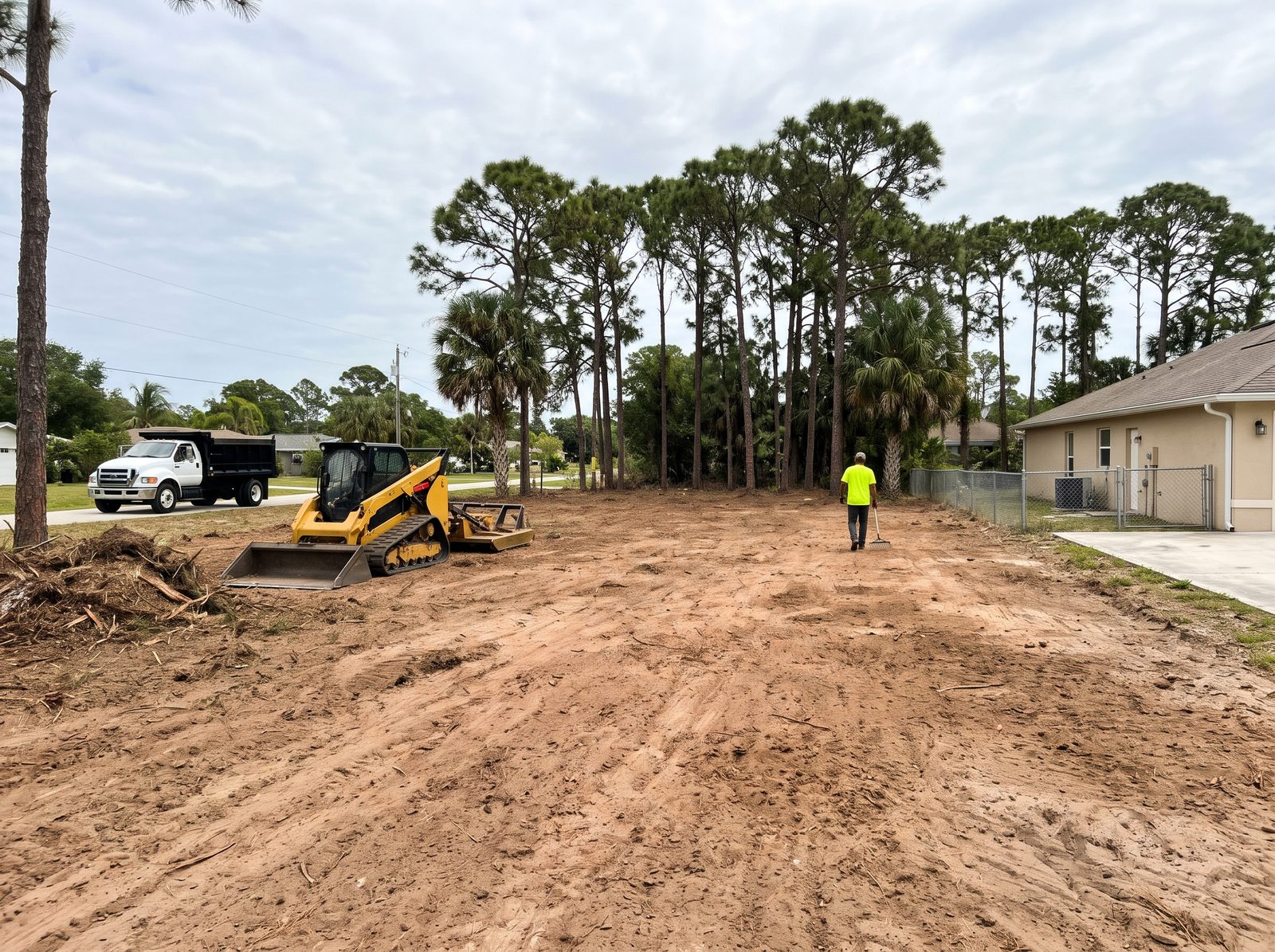
If your property in Lehigh Acres, North Fort Myers or out toward LaBelle has turned into a wall of palmetto, vines and scrub, there are two main ways to get it back. Forestry mulching chews the vegetation up and leaves it on the ground. Land clearing takes it all out, roots included. They are priced differently, they leave the ground in very different shape, and choosing the wrong one usually means paying for the job twice. Here is how to tell which one your land needs.
How Forestry Mulching Works
A forestry mulcher is a heavy machine, usually a tracked carrier, with a spinning drum of steel teeth on the front. It grinds standing brush, saplings and small trees into chips and spreads them across the ground in one pass. Nothing is piled, burned or hauled away.
What you are left with is open, walkable land covered in a mulch layer. Stumps are ground near the surface but roots stay in the soil, which helps hold the ground in place. The topsoil stays mostly undisturbed, and the mulch slows new growth and erosion for a while.
Mulching is a good fit for:
- Opening up overgrown acreage you are not building on yet
- Clearing fence lines, trails, sightlines and property boundaries
- Cutting down dense, dry undergrowth that can fuel brush fires
- Making a lot easier to survey, show or sell
- Managing land between building phases
How Land Clearing Works
Traditional clearing uses excavators, dozers and loaders to push over trees, pull stumps and root balls, rake out debris and load it onto trucks. The vegetation leaves the site, and what is left is bare ground ready for grading.
Land clearing is the right call for:
- A house footprint, driveway, septic area or pool
- Any area that will get fill, a building pad or compaction
- Commercial pads and parking areas
- Sites where the plans or permit require a stump-free surface
The reason is simple: roots and buried wood rot. Fill placed over them settles as they decay, which is how pads crack and driveways sink. See our land and lot clearing service for how that work is done.
Side-by-Side Comparison
- End result: mulching leaves a mulched, rooted surface; clearing leaves bare soil.
- Stumps and roots: mulching grinds stumps near ground level and leaves roots; clearing removes both.
- Haul-off: mulching usually needs none; clearing generates truckloads of debris to dispose of.
- Ground disturbance: mulching is low; clearing is high, which can mean erosion control on some sites.
- Ready to build: mulching usually no; clearing yes, once graded.
- Cost per acre: mulching is usually lower.
What Each One Typically Costs
Published prices vary widely, so treat these as typical market ranges rather than a quote. For forestry mulching, one Fort Myers-area clearing company lists about $400 to $1,500 per acre depending on how dense the growth is, while a Southwest Florida cost guide puts it higher, at roughly $1,000 to $3,500 per acre. For traditional clearing, one Lee County company publishes about $1,500 to $3,500 per acre for light brush, $3,000 to $6,000 for mixed brush and trees and $5,000 to $10,000 or more for dense, heavily wooded land. Density, tree size, access, wet ground and how far debris has to travel all move the number. Every job is quoted after we see the site. Our land clearing cost guide goes into more detail.
Permits and Rules Apply to Both
A mulcher is gentler on the ground, but it is still clearing in the eyes of most regulators. Before either method:
- Check vegetation removal rules. In unincorporated Lee County, a vegetation removal permit is required on properties over 5 acres, over 2 acres on Pine Island, or on any barrier island. Collier County and the cities have their own rules. Start with your county's permitting office.
- Look for gopher tortoise burrows. Florida Fish and Wildlife Conservation Commission rules require a relocation permit before work within 25 feet of a potentially occupied burrow. This applies to mulchers too.
- Don't plan on burning. Burning land-clearing debris in Florida requires authorization from the Florida Forest Service, plus local rules and burn bans. Mulching or hauling avoids the issue.
More detail is in our guide to clearing permits around Fort Myers.
The Combined Approach
On larger parcels, the most cost-effective plan is often both. Mulch the whole property to open it up and see the ground, then fully clear only the building envelope, driveway and septic area. You pay clearing prices on a fraction of an acre instead of all of it, and the rest of the land keeps its mulch cover and natural contour.
How to Decide
- Are you building on this area within the next year or so? If yes, plan on clearing for that footprint.
- Will the area get fill, a pad or a driveway? If yes, clear it.
- Is the goal access, visibility, fire-fuel reduction or upkeep? Mulching usually does it for less.
- Not sure? Mulch first. You can always clear a specific footprint later, but you can't un-clear a lot.
We offer both forestry mulching and full clearing from our Fort Myers base, and we can follow either one with grading and site prep. Wondering about schedule? Read how long land clearing takes.
Frequently Asked Questions
Does mulching cost less than full land clearing?
Usually, yes. Mulching processes vegetation on site and skips stump extraction and haul-off, which are big parts of a clearing bill. Published Southwest Florida prices for mulching run from roughly $400 to $3,500 per acre, versus about $1,500 to $10,000 or more per acre for traditional clearing, depending on density.
Can I build on mulched land?
Not without more work. Roots and ground-level stumps remain after mulching, so the building footprint still needs to be cleared, filled as needed and compacted.
Will the vegetation grow back after mulching?
Some regrowth is normal, especially from palmetto and fast-growing brush. The mulch layer slows it, and periodic touch-up mulching keeps land open.
Do I need a permit to mulch my property?
It depends on where the land is and how big it is. Mulching is generally treated like clearing, so check your county or city vegetation removal rules and look for gopher tortoise burrows before work starts.
Not sure which approach fits your land? Call or text 914-562-4457 with your address and what you plan to do with the property, or request a quote online.