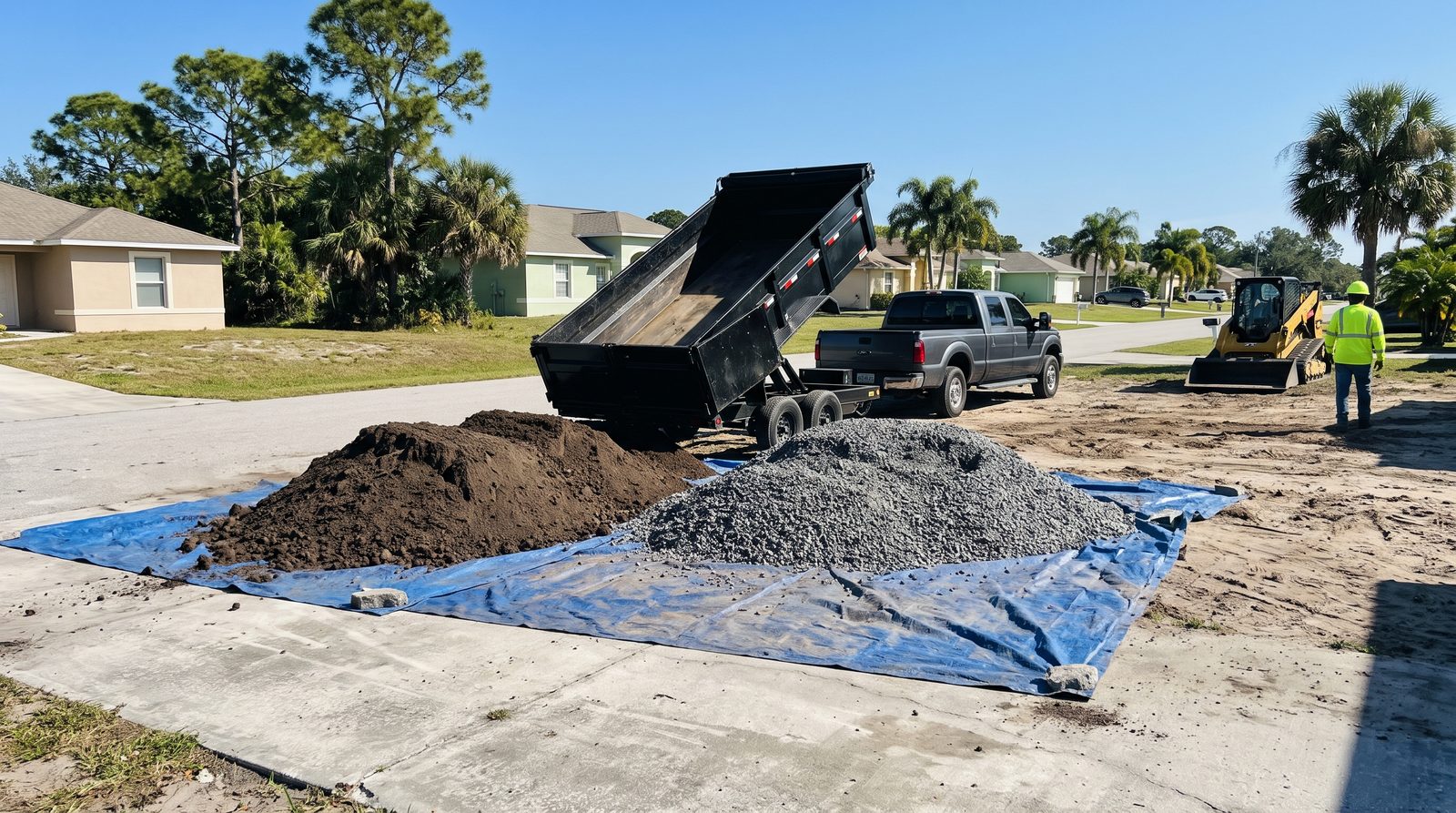
Order the wrong dirt and you usually find out the hard way: a driveway that dips after the first summer storms, or a new lawn that browns out because the sod is sitting on bare sand. Fill dirt and topsoil can look almost identical when they come off a dump truck, but one is meant to carry weight and the other is meant to feed roots.
The Short Answer
Fill dirt is for building up and holding weight. Topsoil is for growing things. If something will sit on it, such as a slab, a driveway, a shed or a pool deck, you want fill. If grass, shrubs or a garden will grow in it, you want topsoil, usually as a thin layer over a fill base.
What Fill Dirt Actually Is
Fill is soil dug from below the surface layer, so it carries very little organic material. Around Fort Myers it tends to be sandy, though loads vary by pit and can include some clay or rock. Because there is almost nothing in it to rot, a properly compacted layer of fill stays put. That is why builders use it to raise low spots, backfill trenches and fill holes left after a pool or stump comes out. The trade-off: sandy fill holds few nutrients, so grass struggles in it.
What Topsoil Actually Is
Topsoil is the darker upper layer that contains decomposed plant matter. That organic content holds moisture and nutrients, which is exactly what sod, seed and landscape beds need. Most lawns only need a few inches of it over a graded base. It should never go under anything structural. As the organic material breaks down, the layer shrinks and shifts, and whatever sits on top settles with it.
Other Materials You Will Hear About in SWFL
- Fill sand: a cleaner, more uniform sand often used for backfill, under pavers and around septic work. Usually sold by the ton.
- Shell rock and limerock: crushed shell and limestone that pack into a hard, drivable surface. A common choice for driveway bases, construction entrances and soft spots that trucks keep sinking into.
- Crushed concrete: recycled concrete broken into road-base sizes. It compacts well and is often priced below virgin stone.
- #57 stone and washed gravel: larger, clean stone that lets water pass through. Used for drainage trenches, French drains and the top layer of some gravel driveways.
Which Material for Which Job
- Raising a low lot or building a pad: compactable fill, placed in layers. See what a building pad is for how that platform is built.
- Filling a removed pool: clean fill, compacted in lifts.
- New sod or seed: a few inches of topsoil over graded fill.
- Driveway or parking base: shell rock, limerock or crushed concrete.
- Drainage trench or French drain: washed stone.
A Cape Coral Note Before You Order Fill
If your lot is in Cape Coral and sits in a Special Flood Hazard Area, the city limits base fill under the foundation of a single-family or duplex home to 12 inches and fill on the rest of the lot to 30 inches or a 4:1 slope, whichever is stricter, unless the Building Official approves otherwise. There are allowances around septic systems and for driveways, walkways and patios, and homes that need more height are built on stem-wall or deepened-monoslab foundations instead. Confirm the amount on your approved plans before you order. We deliver to Cape Coral and can match loads to what your permit allows. Other cities and counties have their own rules, so check with your local building department.
How to Figure Out How Much to Order
Fill and topsoil are priced per cubic yard or per truckload. The basic math is simple:
- Measure the length and width of the area in feet.
- Measure the depth you need in feet (6 inches is 0.5 ft; 3 inches is 0.25 ft).
- Multiply length x width x depth to get cubic feet.
- Divide by 27 to get cubic yards.
Example: a 40 ft x 30 ft area raised 6 inches is 40 x 30 x 0.5 = 600 cubic feet, or about 22 cubic yards. Loose fill compacts once it is rolled or tamped, so plan on ordering somewhat more than the raw number. How much more depends on the material and how hard it gets compacted, which is one reason it helps to have the hauler look at the job first.
What Affects the Price of a Delivered Load
- Material type: fill is usually the cheapest per yard; topsoil, stone and specialty aggregates cost more.
- Quantity: full truckloads cost less per yard than small partial loads.
- Distance: material comes by truck from pits and yards, so a site close to the supply costs less to reach than a town at the edge of the service area.
- Access: soft ground, low wires, tight streets or a dump spot behind a fence all add time.
- Spreading and compaction: dumping a pile is one price; placing, grading and rolling it is another.
For a rough sense of the market, online marketplace listings for Fort Myers in late 2026 showed fill dirt starting around $28 per cubic yard delivered (roughly $500 for an 18-yard truck), topsoil around $63 per cubic yard, fill sand around $40 per ton, crushed concrete around $52 per ton and #57 stone around $61 per ton. Those are starting list prices from resellers, and real prices vary by job. Every job is quoted after we see the site.
On delivery day, mark exactly where the load should go and keep it off septic tanks, drain fields and irrigation lines. From mid-May to mid-October, afternoon storms can soften a lot quickly, so morning deliveries and a shell-rock entrance help.
We haul fill, sand, shell rock, gravel and rock across Lee, Charlotte, Collier and Hendry counties from our base in Fort Myers, and we can follow up with grading and site prep when the material needs to be placed to grade. See our material hauling and delivery page for the full list.
Frequently Asked Questions
Can I grow grass directly in fill dirt?
It is possible but difficult. Sandy fill holds little water or nutrients, so most lawns do far better with a few inches of topsoil spread over the graded fill before sod or seed goes down.
Is topsoil ever okay under a driveway or slab?
No. Topsoil contains organic material that breaks down and compresses over time, which leads to settling and cracking. Use compactable fill, shell rock or crushed concrete under anything that carries weight.
How many cubic yards are in a dump truck load?
It depends on the truck and the material. Fort Myers marketplace listings commonly price a full truck of fill at 18 cubic yards, while heavier materials such as sand, rock and crushed concrete are limited by weight and sold by the ton, often around 21 tons a truck. Ask when you order so the truck matches the job.
How much fill is allowed on a Cape Coral lot?
For single-family and duplex construction in a Special Flood Hazard Area, Cape Coral limits base fill under the foundation to 12 inches and fill elsewhere on the lot to 30 inches or a 4:1 slope, unless the Building Official approves more, with allowances for septic systems and flatwork. Your approved plans and the city's building division have the final word.
Not sure whether you need fill, topsoil or rock? Call or text 914-562-4457 with your address and what you are building, or request a quote online. We will help you pick the material and the amount before the truck rolls.